I'm going to try a different hosting site.
http://sciencespecialist.wordpress.com/
Saturday, September 05, 2009

Sunday, February 22, 2009
Sometimes it's just fun to look at stuff.
Sometimes it's just fun to look at stuff. Like, say, paints that your local artist is using. Of course it's even better if you record your observations.
Here's a paint that is enhanced by the addition of tiny glass beads. When you paint with this stuff, your art work will be shiny like a roadside safety reflector.

So, what's it look like at low magnification under the stereomicroscope?

And what if we wash off the goopy paint part and isolate just a few of those beads in a drop of water under a compound microscope at about 100x?

How did the manufacturer manage to make those beads so smooth?

And
Colored mica flakes, blue and pink, give the remarkable shifting iridescence characteristic of "interference paints" made by Golden Acrylics Corp. Here you see the mica flakes in a paint sample, highly diluted and magnified 400x.
Science news this week was the story of a remarkable type of caterpillar which is a parasite on ant nests. You might know that ants communicate by smell, but did you know that ants communicate by sound too? The caterpillar makes a particular sound which the ants recognize as "I am your Queen Ant. Feed me now!" - - and lives a happy life of ease in the anthill, growing fat on the labors of enslaved worker ants.
If my migraine doesn't recur, I'll try to get back to the Miss Stone story later today. Now that I think of it, Miss Stone might have been a migraineur too.
Tuesday, February 17, 2009
Miss Stone's biology -- part 1 of ?
My high school biology teacher, Miss Stone, taught a high-intensity high-speed course for the aspiring science major. She taught it like a freshman course in a good university: fast lectures, a lot of reading, and high expectations for retention and comprehension. She even added extra after-school sessions in spring for those who were interested. Students who did well in the course and took the extra sessions would reliably pass the AP exam.
And then there was … the Microbiology Challenge. In the middle of the year, an extended lab project required us to grow yeast cultures in test tubes full of nutrient broth. She told us the goal of the project (which I don't remember now), and gave us practically no instructions. Week after week, puzzled and frustrated students (myself included) would find their test tubes, once again, contaminated. Where there should have been a healthy yeast population, there was a cloudy stinky mass of other single-celled invaders. I remember her peeking into the microscope and gleefully asking somebody, "Is that your yeast or your pond water?"
After a few weeks of this, 85% of the class that was still stuck; but we began to notice that 15% of the class seemed to know something we didn't know. They used a number of techniques such as passing a flame over the opening of the test tube every time they opened it for any reason. And their cultures did not get contaminated. Other students began to ask those 15% what they were doing, and word got around bit by bit.
Eventually, after the end of the project, the class as a whole was given the half a dozen standard microbiology methods – flame and so forth—that would allow anybody to do this culture growth successfully (and would have reduced the six-week project to a one-week project).
I still don't know where those 15% got the advance information. Did they corner the teacher after hours and demand extra help? Were they the children of professional scientists? Did they take the bus to Harvard and dig in the science library there?
The real agenda of this project was never stated. I can guess at two things Miss Stone might have had in mind.
- Preventing contamination is really hard. Until you've failed twenty times in a row you won't appreciate this.
- In real life, the "answers" are not given to you in advance. You have to use any and all means (teacher, parents, Harvard library) to solve problems that nobody even told you would exist in the first place.
These are both laudable purposes, but I left with a feeling of frustration around (2). In terminology I learned later in life, I would have said we were "set up to fail". Or perhaps it was a "sink or swim" type of test. Students who – somehow – had already at age 15 grasped lesson (2) were able to demonstrate it and appreciate the success it brought.
Next instalment soon. . . running out of time here . . .
Saturday, February 07, 2009
Density and memory
Today's lesson topic was density. In keeping with Montessorian principles, the same materials can be presented to different age groups, with different levels of discussion. Thus, the K group simply holds and feels the three objects (see picture) and learns the word "density", where the EE group also weighs them. As soon as they get to long division in math class, we could bring the same objects back, measure their volumes by the Archimedean method, and compute the density.
Here are the three objects of different densities (and the scale).

Also in EE we can refer to other objects of higher density. I figure when they jump up and madly run for their astronomy books, desperately eager to show all the pictures, this is a good sign.
Last week's Science Magazine news-of-the-week gave us a discussion on Bacillus Thuringensis. For the K group, we go for the key concept: "These germs kill bugs that eat crops" (good timing, as the Gardening class has been suffering from an aphid attack on one of their cabbages). In EE, we point out the disturbing evolution of Bt-resistant pest insects (and alert students ask how severe is the threat to beneficial insects). Left for next year is the actual content of the article, which had to do with remediation strategies for Bt resistance in the context of genetic recombinants. And several years away are lessons on Monsanto politics… too complicated for now.
This week we did a memory experiment, which was so much fun I think I will add it to the standard weekly protocol.
Start by asking "who remembers last week's News Of The Week", and notice the unanimous response (sudden surprise: omigosh, I just realized I have absolutely no idea!). Then, drop little hints, ("does anybody remember trying to learn a long name. . . something about germs. . . the initials Bt…") and watch as the lights go on one by one around the room. I should probably videotape the whole sequence as there is a ton of good neuroscience in it. Like after about 9.2 seconds people start remembering the News from two or three weeks ago instead, and so on. Or, next class, how much faster will they remember Bt? (average time until the mouth bursts open in an "aha" response: might have been 30 seconds this cycle, will it drop? Linearly or logarithmically? etc)
Of course we also had stinky stuff and blew things up … goes without saying…
Tuesday, January 13, 2009
Local business helps again.
This time it's the Feather 'n' Fur Animal Hospital of 9125 Manchaca Rd. I got into a conversation with them last December when I realized how much microscopy they do - - counting white cells, examining tissue samples, etc. One of these weeks I'm going to get around to buying a good batch of stains so we can prepare really vivid slides for class, but in the meantime they volunteered to give me some nicely stained genuine veterinary slides for the class. So I brought in a blood smear and a little ear cytology slide.


One of the K students brought in a splendid gastropod fossil, but somehow immediately segued to arthropods, and so we learned a little bit of greek (arthros, pod, gastros) and somehow ended up talking about scorpions. They do love to tell personal stories in these classes, and last time I checked my Official Theory Of Learning, I think it said that when the lesson becomes personal then the learning becomes permanent. Not only were we regaled with everyone's tales of Scorpion Encounters, but one of us claimed to have a house and yard practically chock full of the little critters. Now if that is you, please do send one in for class (feel free to kill it first if you like), because I have a UV light and it is really quite neat seeing how scorpions fluoresce in UV light.
So there you have it - - once again the K ran out of time without even getting to the Question Box. We'll have to start the class next week with the Q B.
The EE class is divided into two sections - - half the class has Science Guy while the other half has Gardening Gal, then they swap - - and it's funny sometimes how the two sections will take off in different directions from the same starting point. After sharing today's news (Possible Breakthrough Malaria Vaccine), and the first couple questions, one group got onto Black Holes and - - that was it - - you get somebody excited about Black Holes (and light and perception and gravity and density) and they don't want to talk about anything else for the rest of the day.
The second group marched cheerfully through their questions and moved on to the microscopy instead. Of course they all want More Power in the microscope, so if you find an opportunity on a nice 1000x oil-immersion scope (stereo, with the nice wheel-driven platform), or a cheap used electron microscope, don't let it get away. (While you're at it, we could really use a particle accelerator around here).
By the way, I heard a glimmer of interest last fall about First Robotics competition. At the time things were too hurried and maybe most of our group too young. But I wonder if now is the time to start thinking about it for next fall?
Sunday, December 07, 2008

Here are some things I have learned about K/elementary science.
Styrofoam balls are always good.
Experiencing the lesson with your whole body is sometimes good.
Certain situations are guaranteed disasters.
This week, the K class built insects with styrofoam balls. This basically entails learning the vocabulary head, thorax, abdomen, six legs, antennae. But the bottom line is that everybody loves a styrofoam ball demonstration. We will do water molecules, spiders, and inscets every year; and if somebody figures out 100 more things that can be done with styrofoam balls, we'll do them all. (Now I must away, to eBay, to find a mountain of styrofoam balls and perhaps a volume discount on pipe cleaners).
This week in particular was the right time to build insects because of last week's news item about termites. Termites cannot digest cellulose (i.e. wood), and they rely on single-celled eukaryotes in their gut to do this job for them. However, there's still a problem with this picture: there's no protein in wood, so how can anybody survive on a diet of pure wood? It turns out that neither the termites nor their pet eukaryotes can do it, but inside the eukaryotes are a colonies of a species of prokaryotic single-celled organisms, who can't digest wood, but do have the remarkable skill of capturing nitrogen from the air (a rare and special ability better known for its appearance in bean root nodules). Once you have nitrogen, you can build proteins. (The evidence for this was found not by cultivating the prokaryotes, which is difficult because they can't live outside a termite, but rather by sequencing their DNA, which led an alert scientist to say something like "Hey, I recognize that 4000-base DNA sequence! That's a nitrogen-fixing enzyme!").
The natural followup to a news item about termites, of course, is a lavishly illustrated library book about them. This of course leads to a lively discussion about termites, houses, queens, workers, styrofoam models, African termite mounds and so on; which brings me to another point:
Do you have any termites at your house? Because we sure could use a couple for the microscope. Maybe you have some in the privacy fence around your back yard? I just don't seem to have any termites handy, and the whole K class sure would be grateful if you could send us a few. Feel free to douse them (the termites, not the K class) in isopropanol before sending them to school.
Experiencing the lesson with your whole body is something I keep re-learning from my daughter. I remember last year a discussion about dolphins, and diving, and fish - - and she interrupted to make sure we all had a chance to do a sort of diving-swimming movement to really get the point home. And she does it all the time at home, even during Story Time. A character in the Story might dance with joy and fall down: she has to interrupt the story so she can dance with joy and fall down. This completes the communication. The words, the concept, the complete grokking.
This is why the live-action demo skit for the elementary class was to include seven kids acting the part of protons, while an eighth one pelts into them as a secondary cosmic ray in the form of a neutron, causing a nitrogen atom to turn into a radioactive Carbon 14. (Ultimately this lets us understand the evidence that proves global warming is man-made). But certain situations are guaranteed disasters and these include seven elementary kids packed together. Instead of a nitrogen nucleus, they formed a giggling rugby scrum, and simply could not be brought back on topic. (on the replay, with a second group, I kept the proton kids neatly spaced about a foot apart, and we did much better).
Tuesday, November 25, 2008
More fun w microscopes
Continuing progress on the class project to track productivity of my solar energy panels and day length:

Microscopes repaired!
Both microscopes in the elementary classroom broke last month. I finally tracked down replacement lighting (plus I jiggered with the eyepiece alignment, an area of mechanical engineering where I was definitely in over my head, but I escaped having done no harm and perhaps slight improvement).
The new light source is a big improvement: as you can see the colors are much more true than the old one that burned out.

There is an industrial process called Shot Peen, or, as I like to call it, "world's tiniest hammers". In order to work-harden the metal (of something you are manufacturing), it would be good to hammer it all over. But instead of using hammers, they use a huge quantity of tiny steel balls, shot through a sort of fire hose (something like sandblasting). These pelt the metal and effectively hammer the surface. I managed to acquire some of these, used, and brought them in.

In the microscope you can see the effect that the impact had on the steel balls.


In one group, there was a sudden mass desire to look at blood in the microscope. A diabetic student who has a glucose test kit kindly offered a drop of blood. If you do this at home, dilute the blood with salt water - - that way you can see the individual cells instead of just seeing a swirling mass of red.

The cells tumble slowly around so you can see some of them edge-on, or tilted, or face-on just looking like circles. It gives you a nice sense of the actual shape of the cells.

Monday, November 10, 2008
See the invisible light
Interesting discovery during science class
Your ordinary digital camera can "see" infrared light (the signals sent by your TV remote) that your eye cannot see. Try it at home.
Note: some TV remotes also make an irrelevant visible red flash along with the invisible IR light that carries the actual signal.
Your ordinary digital camera can "see" infrared light (the signals sent by your TV remote) that your eye cannot see. Try it at home.
Note: some TV remotes also make an irrelevant visible red flash along with the invisible IR light that carries the actual signal.
Sunday, November 09, 2008
Lousy movies
Monday, September 22, 2008
Sound waves and yarn spinners
Well, I got more fun today out of Grandmother's Waterford crystal than I have in years. Decades ago, unsure how to entertain her eccentric grandson-in-law, Grandmother would hand him a shot of Scotch whiskey on ice in one of her Waterford glasses. This social nicety taken care of, she could go ahead and have a pleasant chat with her beloved granddaughter and everyone would have a lovely time.
When she died, she left me the Waterford set, which I dutifully packed in bubble wrap and transported to Texas. I even bought a big ol' china cabinet to display it in. This week (in response to Science Question of course) I brought in a glass to show the ringing effect of crystal hitting its resonant frequency (Never heard it? Here's a nice example on youtube ). Everybody had a lovely time.
Also in the discussion - - how to sing into a guitar and hear the guitar string ring back at you (this worked well), and how to induce a standing wave in a piece of string tied across the classroom (this worked . . . um . . . let's just say that the kids were pretty nice about saying it worked).
Remember to tell 'em to keep those questions coming, folks.
In the K class I read out loud the recent news bulletin from Science magazine about a new way to pick up latent fingerprints on plain metal (criminals beware! wiping the gun doesn't work anymore), and then somehow found myself getting all messy showing an example of my own fingerprints. So if your child has been rubbing ink on her finger and making prints at home - - well - - yeah, it's my fault. I'd like to come back to fingerprints next session and give everybody a try (there's a nice tie-in with using the microscope). I also think fingerprints (and, for that matter, all biometrics) are a serious matter of privacy, so any fingerprints taken in class will remain either (a) completely anonymous, or (b) in the exclusive possession of their owners. I don't think the subtleties of information security are particularly easy to explain to five-year-olds. (Then again, the only rule that has held up under inspection so far has been "they understand more than you expect - - no matter where you set your expectations").
Over in K class a student brought in a surprisingly large and furry dead bee (bring on the microscope). I have ordered a Field Guide to Insects and will bring it in to class: perhaps we'll be able to identify the bee.
The K class also produced a fine crop of questions. Once again, How Heavy Is The Sun - - (back to the library for that one!) .
Also we had a good go-round starting from a question about snake venom. Here's a funny thing, and this happens often. I tell them something about, oh, say, a time when I met a rattlesnake on a hike, and it turns out that most of them have also met rattlesnakes on hikes! One after another, with perfectly straight faces, they'll all tell me about their snake encounters. This must be a way that brains learn: you put yourself in the story and you say it back like it was your fact all along. It gets even better when somebody in the class is a real yarn-spinner (which there is always one), and you get a complicated story about how the snake did bite him, only it got his boot and not him, but it pulled his boot off, and they had to have a fight to get the boot from the snake, and on and on . . .
No class next week - - I'm out of town.
Sunday, September 14, 2008
A project begins
In the Elementary classroom, I started a project to graph day length and solar energy output (in my new home solar photovoltaic unit) for the duration of the school year. I introduced the big posterboard which will ultimately have about 35 weeks' data on it. Now it has just one dot and a lot of empty space. Nobody seemed to know what I was starting here, which is just fine with me. I'll let it become clear slooowwwly as the data points are filled in. I figure each week I'll have a different volunteer to actually put the dot on the graph - - that should be fun.
Also, it turns out that the math problem "how many minutes of daylight did we have today, if the sun rose at 7:14a and set at 7:32p" is a pretty tough one for elementary school. I'll decompose it to its component parts and let it settle in over a week or two.
Or, heck, I could make a Worksheet out of it.
Somebody asked about sweat last week, so I brought in a book with a really neat diagram of a sweat duct and pore. This is a recurring theme. You ask a question: next week a library book shows up. Parents: if you haven't been to the library lately, go check out the science section of the Juvenile book shelves. The quality of science writing and publishing has skyrocketed since you were a kid. Remember those dry, condescending, poorly illustrated science books they used to have? Those are gone, gone, gone! Today's kid science books are terrific. The photos are spectacular, the facts are well presented, there is good depth.
It was from this week's Kid Science library book that I learned how to get skin cells onto a microscope slide, using a magic marker and a piece of scotch tape. The brown color is from the magic marker and makes it easier to find and focus on the skin cells. This slide was prepared during class and everybody saw this image (the microscope is wired to a large TV monitor).

There was a good discussion about Hurricane Ike; I brought in satellite photos showing the storm Bigger Than Texas.
I did not bring in a ringing crystal wineglass, which definitely was a faux pas, since we had talked about them the week before ("how can a singer smash glass?"). Naturally your children let me know in a firm but friendly way that I had omitted something. Firm but friendly translates to, good grief! I'd better not forget again!
In the K class we also talked about Hurricane Ike. The library books for K were about the moon, because of last week's question about moon rocks. Also I brought in a demonstration of how craters form.
Here is the moon's surface, also known as a lunch cooler filled with dry grout.

Close-up view:

And here is the moon's surface, cratered after being pelted by meteors, otherwise known as driveway pebbles dropped by seventeen small hands.

Here's one of those moments of delight: We talked about the moon being waterless. One student was clearly puzzling over several elements at once: hurricane clouds are wet, hurricane clouds are high above us, the moon is dry, the moon is high above us. You can tell he figured it out and found the way to make all the facts fit together properly, because he raised his hand to ask, "So. . . the moon must be higher than the clouds, right?".
Perfect.
Saturday, September 06, 2008
Questions; Fire and Ice
Well you just don't know how these classes are going to turn out. I walked into K with a planned demo (one of the annual favorites . . . wait for it . . . it'll come up), and nosed around the Question Box first, and found it empty.
That's not right.
Gotta have Question Box.
I figured maybe a practice round would be a way to reinforce the message about "go ahead and use the question box". So I asked if we could have one, just one, person do a live-action demo of
And yes, I realize that while some of your kindergarteners are writing a weekly op-ed for the New York Times, many are at something more like a write-one-letter-and-then-draw-a-picture stage. If they prefer, they can ask for help writing their question. Early in the academic year, I typically see question-box questions in several formats, such as
(One of the cool things about this game is watching how the question cards advance into stage 3 as the year progresses; and stage 4 cards become extinct)
Having caught half a glimpse of the live-action demo, everybody wanted to do it. Ten minutes later the Question Box was properly stuffed.
Now there have been some back-and-forths around what to do with a wealth of question cards.
One idea is to take the top question, and give it as much time as it needs, fill in the needed background, let the conversation run wild, and only go to the second question when things simmer down a bit. The advantage is that you get really good learning and lots of fun besides. The disadvantage is that if science class lasts under nine hours you don't get to everybody's question, and some question-writers feel left out.
Another idea is to just read everyone's question out loud. Uncle Robby claims that just by hearing his own question the child has engaged intellectually and may already be satisfied. I am a little skeptical of this, though. "All right, I engaged intellectually and twenty-seven professors of child psychology say that I have met my developmental level. Now answer the darn question!"
A modified-Uncle-Robby approach I tried last year was to read them all, then choose a few to discuss. The grapevine tells me that the preterite knew dang well they were being left out.
So now I'm considering - - read all of 'em, give every one at least a short answer, but a serious, factual, targeted answer (even if it leaves a heap of mysteries dripping from every syllable like algae on a Swamp Beast) - - and then choose one or two for exegesis. We'll see how this works. In any case, that's supposed to be part of The Art of Montessori Teaching:
Right words, fewest words.
This week, anyway, we ran out of time before getting through them all. And my prepared demo stayed in its box.
Over in Elementary - - my goodness, this is getting long: are you still reading? . . . because of last week's question about getting frozen and brought back to life, I brought in some examples of what happens when you freeze water, and how it stretches, distorts, or shatters its container. These were pretty well-received. I wanted also to show that most substances (unlike water at zero degrees C) expand with warming, not cooling. Have you tried building a demonstration of this? It's not easy! After bungling around the garage half the night before, I ended up with a variation on the tightrope demo. It worked pretty well at home, but you had to be rather forgiving and optimistic to say it really worked at school. Fortunately, anything with fire is fairly satisfying to a classroom audience.
Followup questions about pond eutrophication and solar energy proved that yes, they certainly are listening. New question-box offerings asked about sweat and death (that sounds almost like a book title).
That's not right.
Gotta have Question Box.
I figured maybe a practice round would be a way to reinforce the message about "go ahead and use the question box". So I asked if we could have one, just one, person do a live-action demo of
- have a question
- write it on a card (or get help writing it on a card)
- pop it in the box
And yes, I realize that while some of your kindergarteners are writing a weekly op-ed for the New York Times, many are at something more like a write-one-letter-and-then-draw-a-picture stage. If they prefer, they can ask for help writing their question. Early in the academic year, I typically see question-box questions in several formats, such as
- A couple of cryptic forms and squiggles
- A bunch of letters wandering about
- A bunch of letters that, on careful examination, bear some relation to words. These are great fun as one can, with a certain amount of practice, actually read them.
- Extremely clear writing with a suspicious resemblance to the teacher's handwriting.
(One of the cool things about this game is watching how the question cards advance into stage 3 as the year progresses; and stage 4 cards become extinct)
Having caught half a glimpse of the live-action demo, everybody wanted to do it. Ten minutes later the Question Box was properly stuffed.
Now there have been some back-and-forths around what to do with a wealth of question cards.
One idea is to take the top question, and give it as much time as it needs, fill in the needed background, let the conversation run wild, and only go to the second question when things simmer down a bit. The advantage is that you get really good learning and lots of fun besides. The disadvantage is that if science class lasts under nine hours you don't get to everybody's question, and some question-writers feel left out.
Another idea is to just read everyone's question out loud. Uncle Robby claims that just by hearing his own question the child has engaged intellectually and may already be satisfied. I am a little skeptical of this, though. "All right, I engaged intellectually and twenty-seven professors of child psychology say that I have met my developmental level. Now answer the darn question!"
A modified-Uncle-Robby approach I tried last year was to read them all, then choose a few to discuss. The grapevine tells me that the preterite knew dang well they were being left out.
So now I'm considering - - read all of 'em, give every one at least a short answer, but a serious, factual, targeted answer (even if it leaves a heap of mysteries dripping from every syllable like algae on a Swamp Beast) - - and then choose one or two for exegesis. We'll see how this works. In any case, that's supposed to be part of The Art of Montessori Teaching:
This week, anyway, we ran out of time before getting through them all. And my prepared demo stayed in its box.
Over in Elementary - - my goodness, this is getting long: are you still reading? . . . because of last week's question about getting frozen and brought back to life, I brought in some examples of what happens when you freeze water, and how it stretches, distorts, or shatters its container. These were pretty well-received. I wanted also to show that most substances (unlike water at zero degrees C) expand with warming, not cooling. Have you tried building a demonstration of this? It's not easy! After bungling around the garage half the night before, I ended up with a variation on the tightrope demo. It worked pretty well at home, but you had to be rather forgiving and optimistic to say it really worked at school. Fortunately, anything with fire is fairly satisfying to a classroom audience.
Followup questions about pond eutrophication and solar energy proved that yes, they certainly are listening. New question-box offerings asked about sweat and death (that sounds almost like a book title).
Monday, September 01, 2008
Questions, microscopes, new school year
blog 2008-08-29
Greetings to all, and welcome to a new year of Science Specialist Blog. This is where I keep you informed about what has happened during Science Time.
For those of you new to the game (like, say, the entire Kindergarten), the centerpiece of Science Time is the Question Box. Any student who thinks of a science question – any question – at any time – is invited to write it down on a card and stuff it in the box. This includes questions that have baffled your parents at home, as well as questions that you think of during school time.
On Fridays we open the box and your very own Science Specialist tries to reel out a compelling answer. This usually requires something between a single word and three weeks' topic development.
K class:
To get warmed up this week, I introduced the stereomicroscope. Here's my favorite link on stereomicroscopes: Making the microscope loom large in a child's life.
So we looked at some seeds such as these Queen Anne's lace seeds (the ones that stick to your socks)

A few kids got practice using the focus knob. The idea is that ability-to-focus should spread like a mind virus in the classroom and everybody should be using the microscope all week to look at bugs, twigs, sand, fingernails, dust, and so forth.
Elementary:
The plan was to talk about the pond near my house, which is being overwhelmed by duckweed:

and then consider going on to research about "what on earth can we, or should we, do about this? With consideration to these before/after photos


There was, however, a lively interest in whether you can have yourself frozen and then wake up 200 years in the future - - there's a good demonstration waiting to happen here - - stay tuned. (By the way, I usually prepare demonstrations rather than experiments for the class. If I already know what's going to happen, it's not an experiment).
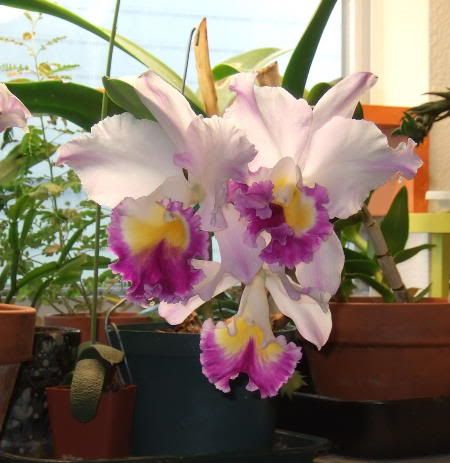
Every science class is better if there is something to smell, too; so I brought in this houseplant which had conveniently blossmed and has a powerful aroma.

Greetings to all, and welcome to a new year of Science Specialist Blog. This is where I keep you informed about what has happened during Science Time.
For those of you new to the game (like, say, the entire Kindergarten), the centerpiece of Science Time is the Question Box. Any student who thinks of a science question – any question – at any time – is invited to write it down on a card and stuff it in the box. This includes questions that have baffled your parents at home, as well as questions that you think of during school time.
On Fridays we open the box and your very own Science Specialist tries to reel out a compelling answer. This usually requires something between a single word and three weeks' topic development.
K class:
To get warmed up this week, I introduced the stereomicroscope. Here's my favorite link on stereomicroscopes: Making the microscope loom large in a child's life.
So we looked at some seeds such as these Queen Anne's lace seeds (the ones that stick to your socks)
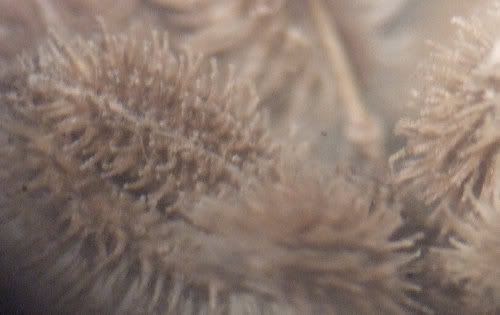
A few kids got practice using the focus knob. The idea is that ability-to-focus should spread like a mind virus in the classroom and everybody should be using the microscope all week to look at bugs, twigs, sand, fingernails, dust, and so forth.
Elementary:
The plan was to talk about the pond near my house, which is being overwhelmed by duckweed:
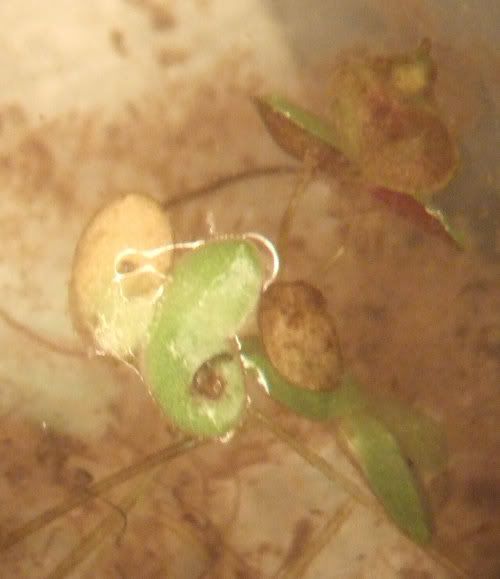
and then consider going on to research about "what on earth can we, or should we, do about this? With consideration to these before/after photos
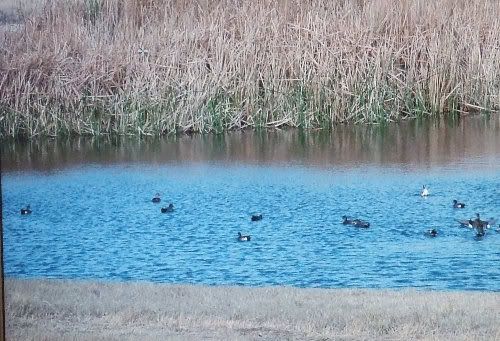
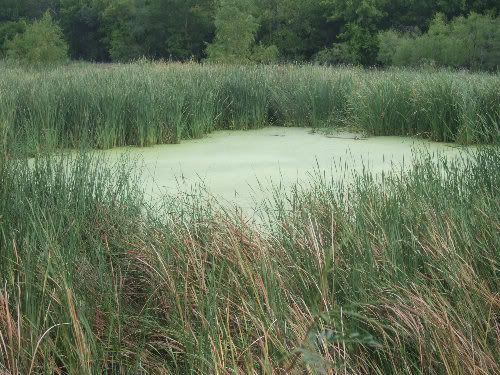
There was, however, a lively interest in whether you can have yourself frozen and then wake up 200 years in the future - - there's a good demonstration waiting to happen here - - stay tuned. (By the way, I usually prepare demonstrations rather than experiments for the class. If I already know what's going to happen, it's not an experiment).
Every science class is better if there is something to smell, too; so I brought in this houseplant which had conveniently blossmed and has a powerful aroma.
Tuesday, August 19, 2008
Late start
Due to travel for my day job, I am unable to host Primavera Science this week. We'll get the year started next Friday.
For those of you kind enough to be checking out the blog already, your consolation prize is this Zombie Feynman cartoon.
Wednesday, May 28, 2008
See you in the fall
I realize that my blogging got kind of intermittent this semester. I'll try to return to full-force reporting next fall.
Thank you for lending me your children this year. I have been fortunate to experience their enthusiasm and humor. They welcomed me to class with eagerness and friendliness beyond all expectations, and kept things exciting with creative suggestions, thoughtful questions, and avid participation.
Until August, good night and good luck.
Thank you for lending me your children this year. I have been fortunate to experience their enthusiasm and humor. They welcomed me to class with eagerness and friendliness beyond all expectations, and kept things exciting with creative suggestions, thoughtful questions, and avid participation.
Until August, good night and good luck.
Tuesday, April 15, 2008
Planets v2.0, Fizzy Stuff v2.0, and Assistants
Fizzy stuff in Silver Surfers. Last week we graphed the amount of baking soda versus the amount of vinegar required to exhaust the fizziness. It did make a rather nice straight plot, as it ought. So I figured a counterexample might make the point that the straight line is remarkable - -that you don't always get a straight line. Enter, again, the yeast and peroxide. Since the fizziness is caused by an enzyme, it ought to be able to keep fizzing and fizzing no matter how much peroxide you slosh in there.
I think the experiment came out a little muddy, there were probably some dilution effects that I should have figured out how to work around, and I'm not sure the theoretical underpinnings were understood all that well, but I got a chance to exercise some improved technique involving Classroom Assistants.
Beginner's approach
Set out the three beakers. Weigh different amounts of yeast in them. Weigh the peroxide into them. Wait a minute, let everybody talk about what they see. Weigh more peroxide into them.
Advanced teaching technique
Ask for an assistant to set out the three beakers.
Ask for another assistant to weigh 5g of yeast into the first beaker.
Ask for another assistant to weigh 15g of yeast into the second beaker.
Ask for another assistant to weigh 25g of yeast into the third beaker.
Ask for another assistant to weigh 100g of peroxide into the first beaker.
Ask for another assistant to weigh 100g of peroxide into the second beaker.
Ask for another assistant to weigh 100g of peroxide into the third beaker.
and so forth.
Really, it's not all that different from cooking-with-kids at home. Except that ideally you figure out a way that you need at least 21 different things done that you couldn't possibly do yourself.
Both classes got to sniff some genuine ammonia, as in "Titan, a moon of Saturn, may have an ocean of liquid ammonia under its outer crust".
Sniffing is a definite winner. I wonder whether it's possible to think of something different to bring in for sniffing every single week all year.
Planets v2.0 - - long-time readers may remember the Lead Balloon of a demonstration over a year ago, where I brought in materials for scale models of the sun and planets. To an adult, the physical visualization and the counter-intuitiveness of the size ratios are astonishing. The class gave it the grand ho-hum.
A week ago, I asked the K class "Is there anything anybody would specifically like to request as a demo or activity?" and somebody piped up and asked, "how about a scale model of the solar system?". AHA! Now is my chance to replay the solar system (v2.0) under Cognitively Optimal Circumstances!
The show was greeted with - - well, I think they liked it pretty well, and it certainly kept focus, but I can't honestly finish that sentence with "odes and paeans of delight". And it still feels like there's something a little too abstract about "this corn grain is the earth, that basketball is the sun" - - something that the 6 yr old just can't get completely into. Still, when it's the child's request that brought the thing into class in the first place, he's willing to work the old gray matter pretty hard, and the kids sitting around him are hooked in too. I bet if the same model pops up in a couple years they'll be, as it were, primed up to "totally get it" in seconds.
Plus I managed to require about 15 assistants in setting out the model planets.
Monday, April 07, 2008
Ad astra per asperam
The K bunch have certainly developed the capacity to follow a long conversational thread. I come in and, as they say, release a conversational hare, and they're off like a pack of bloodhounds. I like to start the class with one news tidbit each week just to emphasize that there is always new material which won't be in your textbook or prepared curriculum. Lately there have been several news items about astronomy. Cassini sends back information suggestiong that one of Saturn's moons has rings of its own, and another one may have an ocean of liquid water (or ammonia perhaps) underneath its frozen methane outer shell. The Spitzer space telescope (yes, Spitzer, not Hubble - - did you know that there are four space telescopes?) detects a nearby star with dust clouds that appear to be in the pre-planetary stage, like our own solar system about 7 billion years back. And in the K class the hands sprout up like bamboo (on my mind because of the bamboo at Norwood Park, also called Dog Park, where they did a major thinning recently and now new shoots of bamboo are growing at about four feet per week), and the conversation takes off like, well, a rocket. I still bring in something intriguing to demonstrate each week, and reserve some time for The Question Box. They are enthusiastic about the demonstrations. This week it was Things that Do and Do Not Fizz with Baking Soda ( vinegar, alcohol, water, lemon juice). And if we don't get to the Question Box, woe betide us! Because those questions are important and the writers will insist and persist until they get their air time.
But our biggest problem is always that we run out of time in the midst of whatever it is, because everybody has something to add, or some point they want clarified, or some extension they are puzzled by. Are you wondering whether your child is participating adequately? The answer is Yes.
Also due here is a shout-out to the classroom guides who provide just the right quiet corrections to keep an animated fifteen-person conversation from turning into a chaotic hubbub.
Over in SilverSurfers, I am following a textbook suggestion that the older group, developmentally speaking, starts to appreciate more leadership rather than unstructured topic selection; and also appreciates topics that continue and grow over time. So, we started with Things that Do and Do Not fizz with Baking Soda, but then (thanks to A.T. for the suggestion) segued into How Much Vinegar does it take to "use up" a certain amount of baking soda. Last week we collected data to answer the question, and this week we all made graphs. I don't think they've graphed experimental data before, and you could hear the electrical crackling in the room as twenty trillion neurons said "whooooaaah.. this is something new, and I get it".
I'm also trying to have us learn a couple new bone names each week. We hang velcro-tagged labels (in Montessori lingo, Nomenclature Cards) on the classroom skeleton. The children are then free to examine these tags, and remove them and reapply them, during the school week.
The What Kids Do textbook also says this is an age where the sense of fairness and justice is developing and is a key interest. That sounds nice and sweet, right? We develop a sense of justice. How lovely. What the textbook author (who is at home giggling as his readers get out into the classroom and discover the subtle understatement) omitted was that this really means a prolonged hurricane season of melodramatic and tragic storms at every microscopic suggestion of unequal treatment. Who got to sit next to The Science Guy today? Why didn't I get to? Who got to help hand out the graph paper? Does everybody get a turn at opening the Question Box? When is my turn? He sniffed the vinegar twice! and so on.
Sunday, March 02, 2008
Science Specialist FAQ: The Question Box . . . plus segue
It's been a year and a half since the introduction of the Question Box, and new folks have arrived here and there, so I worry that not all you parents know about The Question Box. In each classroom I have placed a Science Question Box (hand made and finished in clear coat to bring out the natural wood grain, in proper Montessori style). The students are to stuff it with any and all questions that occur to them. On Wednesdays I open it and try to answer the questions.
The original plan was to try to answer them as I pull them out, a big flying game of high-risk Stump the Chump. This year I tried a variation on the protocol, where I read all the new questions out so each child could know that his question had been acknowledged; then I picked one or three to answer this week or to follow up on later.
I don't like how the variation has worked. I think they first thrill to hear their very own question, then they are let down when they do not get air time right away. Or, worse, they are slighted when I read five fascinating questions and then choose only one to actually pursue.
I have noticed the older group has been providing questions at a much lower rate than both (a) the younger group, (b) last year's performance by the older group. Just in time I come to a paragraph in my How To Be A Montessori Elementary Teacher book that informs me of a tendency observed in all children as they enter the Second Plane (roughly age 6-12), a lowered desire to dive into new subject matter or to inquire madly in all directions. As a consolation prize, they develop more interest in a prolonged, deeper inquiry. Their Science Specialist would be well advised to surf on this developmental change.
Skeleton
I imagine you've already heard: our school now boasts a fine 4-foot tall skeleton model. It inhabits the Silver Surfer classroom. Although the K group got a good look at it as well, it was really bought in response to questions from SSurfers, and with plans in mind to develop both science and art lessons for this older group.
Tuesday, February 12, 2008
Local optician supports science specialist
You may remember a couple weeks ago I was trying to borrow a pair of polarized sunglasses for the science demo. Our friendly local optician, Mickey Stasey of South Austin Optical ( 4413 Pack Saddle Pass, 447 2333) lent me one for the day. Thanks to him, our kids got to see that a pair of polarized lenses at right angles to each other blocks nearly 100% of a laser beam.
Subscribe to:
Posts (Atom)